
A Paper for Discussion....
At the National Festival in August the IWA announced the Save Our System (SOS 2010) campaign. Members of Save Our Waterways (SOW) and other waterways' enthusiasts could be forgiven for being a mite confused as the name and detail of the campaign seemed strangely familiar.
SOW takes this as a compliment and, as such, we had no problems in deciding to support the aims of the campaign along with other boating user groups.
The central theme of the campaign is to encourage the formation of community-based advocacy groups who will identify and promote local benefits and issues to their communities at wide. The Winter 2009 issue of IWA's 'Waterways' magazine encourages branches and regions to take the lead and convene local meetings with other stakeholders and centres of influence. This is a great opportunity for IWA to demonstrate the grass roots influence that should be part and parcel of an organisation with 18,000 members, and I look forward to being contacted by my local branch.
As IWA Chairman, Clive Henderson has pointed out, the cut recently announced by DEFRA has virtually wiped out the £5-10 million annual saving that BW will be squeezing from their operating costs over the next 10 years.
These savings have largely come at the cost of jobs and, as such, this seems a particularly pernicious act on Government's part. Furthermore, there are now renewed reports that BW's property portfolio is to be put up for sale and if there is any substance in this report we have solid grounds for mass protests.
Clearly any campaign activity needs to allow enough time to influence election manifesto promises and as the election date could be as early as the first week in May 2010, it is clear that we need to making preparations for a campaign no later than March. We organised 50 protests in November 2006 from scratch in 6 weeks so we can surely achieve that by working together with determination and commitment.
SOW believes that any protest should focus on stopping the 'sale of the family silver' and to use the £30 million funding short-fall to emphasize the critical state of BW finances. As long as this country is recovering from the recession, we suggest that it will be counter-productive to focus the campaign on trying to get DEFRA or any other government department, to cover the £30 million funding shortfall. In our view, the answer to medium and long term funding is to transfer more financial responsibility to local and regional authorities.
When the re-write of 'Waterways for Tomorrow' is released this winter, it is expected to contain numerous references to 'greater community' involvement. It will also feature the research commissioned by DEFRA/IWAC which clearly demonstrates that waterways are a sound economic investment as well as meeting universally held social objectives.
The central theme of the BW AGM in October, 2009 was its 2020 Vision, which sees its future as a Third Sector, charity-like organisation that relies more heavily on volunteers, public donations and working more closely with local authorities. Comparisons were made with comparable Third Sector organisations that are managing their 'estates' without being reliant on financial support from government. Organisations like the RNLI, RSPB, Ramblers and, notably, the National Trust and the Woodland Trust, do so with the support of thousands of volunteers and significant fund raising activities.
The better use of volunteers has, of course, long been a point of contention with BW. The culture within BW – from top to bottom – needs to change dramatically from one that gives lip-service to the concept to one that embraces the volunteer culture and delegates functional and managerial responsibilities to volunteers. WRG and the societies that run restoration projects and manage navigations on a volunteer basis are excellent examples of professionalism that should be an intrinsic part of a Third Sector BW and we all need to find ways to catalyse the formation of complementary groups in other areas of expertise. The formation of community support groups would be a good start.
BW have a significant advantage in this regard. As NABO has pointed out, which other Third Sector organisations have such a large body of boat-owning stakeholders with a vested interest of perhaps as much as a billion pounds? Which other body has a defined market of property-owners along 2,200 miles of waterway? Which other body takes care of a recreational resource that passes through the local community of nearly 20 million people (250 parliamentary constituencies)? All of these people are potential supporters of any initiative that will want to protect and improve the recreational value of our waterways.
The idea that riparian communities should play a greater role in the upkeep and future of their local waterway makes a lot of sense. It is, after all, local residents that reap most of the benefits of a thriving, vibrant waterways: the recreational benefits; enhanced property values; the trade and related jobs from passing boaters, walkers, cyclists, anglers etc. Conversely, it is the anti-social behaviour of those local residents that use the waterway for fly-tipping and honing their graffiti skills – acts that cost BW millions each year to clear and deter paying visitors. Factor this with statistics from BW's surveys which suggest that 95% of users are local people enjoying the towpaths as a means of personal recreation and it is clear that local authorities should be taking more responsibility for the costs of maintaining the waterside in good order.
With or without a protest campaign, we could make good use existing waterside festivals to start to build community-based groups of activists from all types of users. We must find ways to involve all types of users; it simply must be a priority to make sure that we have non-boating interests properly represented.
At the beginning of 2009, SOW chaired a meeting in Westminster where the heads of major user groups briefed Ann McIntosh, Shadow Environment Minister, on the major issues facing the waterways. During that meeting, the idea of a National Waterways Authority was raised and Ms McIntosh referred us to a website which contained a series of documents that represented current Conservative thinking, thinking that we presume will become a part of their election manifesto..
The most relevant of these is entitled 'Water – The First Essential' and it makes a powerful case for a National Water Association which would regulate all aspects of sustainable water management. The rationale for a single overseeing body is that 'integrated water management cannot be provided while the responsibilities for regulating its interrelated components remain in different hands'. Central to this is the European Water Framework Directive (WFD) which is targeted to be implemented by 2015. The paper was written
While the NWA 'would have overall responsibility for all matters related to water, is not intended that it should act as an arm of government. It is intended that it should be an instrument of all those who have a direct interest in the good, long term management of water. In voluntary terms, it is more like the CPRE or the Wildlife Trusts whose strength lies in their local organisations.' The NWA envisages the establishment of volunteer community groups based on local water catchments. Bodies – such as private companies, local interest groups, local authorities, community collective, etc – would be invited to tender for the responsibility to establish these community catchment groups and ensure that they were fully integrated into the local decision process.
The document names British Waterways as one of these 'bodies' and it may be more than coincidence to that much of BW's 2020 Vision plan is designed to neatly fit this proposal. The proposal is that BW 'be entrusted with responsibility for navigation and recreation in all inland and transitional waterways, man-made and natural. The Port of London Authority would be disbanded and its duties subsumed by BW. The former EA responsibilities relating to navigation and recreation would also be transferred to BW. The new BW would be regulated as a service provider by the NWA in order to ensure that it acted in a sustainable manner and balanced navigation and recreation needs against the other components of sound integrated water management.'
The devil in this proposal is the detail. Clearly, a straight merging of EA (and by implication other navigations too) would attract a significant amount of opposition from waterway stakeholders. SOW's paper on the concept of a strategic waterways authority approached this particular issue in a less contentious way but there are clearly many other implications of such a dramatic new concept that need to be debated by all stakeholders with a view of reaching a consensus before Conservative election policy is finalised.
Will Chapman
Please add your thoughts on this by clicking the link below.
Thursday, 19 November 2009

Tuesday, 17 November 2009
BW Talks Down Sell-off Story
Following an item on The Politics Show on Sunday 15th November, speculating that the government could be about to sell off British Waterways' property asset portfolio, BW has played down the story.
BW points out that the government decided earlier in the year, following a Treasury-led review, that British Waterways' 1,400 canalside properties should not be sold. (See earlier story.)
BW chairman, Tony Hales, said: "We were comforted by the Government's report in April. We generate almost half of our annual maintenance budget through property-related activities which have been fundamental to the renaissance of our 200-year old waterways over the last decade. Without it the public cost of caring for the waterways would increase significantly. With the reduction in grant funding in recent years the income we have generated from property and other sources has been crucial to the funding and revival of the 2,200-mile network."
"Earlier this year we proposed setting up a "national trust" for the waterways to safeguard their future and lessen the call on the public purse. The proposal, which has received widespread support, would only be possible with the income we generate from our property and with long-term government funding agreements."
It seems possible that the programme was running with the story from earlier in the year as there is not thought to have been any new decision about BW, although BW acknowledges that the government keeps all assets under review in the light of the current financial situation.
It would be a very short-sighted decision if the government were to sell off BW's property portfolio. Not only would the amount raised not be great in a recession, but it would deprive BW of a vital source of income, meaning that the government would have to pump additional money into BW in the future just to maintain the system at a basic level.
This might be a good time to contact your MP to make sure they are aware of this and to encourage them to use what influence they may have to help ensure that BW's assets are not flogged off in a pointless fire sale.
Thursday, 5 November 2009
Who Pays for Waterways?
Who Pays for Waterways? Who should pay? SOW's Will Chapman stresses that we need to keep the plight and opportunities of the waterways in the public eye:
Even before the recession, the navigation authorities have been severely under-funded. Brititish Waterways is short by as much as £30 million a year and, as a result, cannot do even the minimum maintenance required. This is having an effect on the condition of canal assets, such as bridges and locks, dredging canals and maintaining towpaths and the surrounding vegetation.
On top of that, there is an unreasonable expectation from some local authorities who seem to think that vandalism caused by local residents should be cleaned up by the navigation authority rather than themselves. In some areas fly tipping is a major problem, with supermarket trolleys, household furniture, fridges, bikes, tyres, etc. being dumped in the canal and left for BW to remove. BW spends between £8-10 million a year on clearing up after local residents.
Local Groups Can Help, Too
Fortunately, some local authorities recognise their obligations in this regard but it is by no means universal. Credit should also be given to those local organisations like the Birmingham Canal Navigations Society (BCNS) that organise regular cleaning parties of Black Country canals. I think that one of these recently removed 12 supermarket trolleys from a single lock!
If our inland waterways are to survive the long recovery period that will be necessary as we come out of the current recession, we will need more cooperation from local authorities and groups like the BCNS as it is extremely unlikely that any additional support wil be coming from central government (in fact, they have recently imposed yet another cut of £5 million).
Should Users Bear The Costs?
It's not practical to fund waterways by increasing the charges to boaters and anglers - by far the greatest number of users of the waterways use the towpaths rather than the water. Annual surveys by British Waterways show that of 250+ million visits each year, over 95% of those using the towpaths are enjoying a family walk, exercising dogs, etc. and it is generally accepted that they could only be ‘charged’ through their local council.
Cyclists are subject to permits in some areas but these are usually free even though cyclists are amongst the main beneficiaries of towpaths, with many using the towpaths to travel to and from work.
The remaining 5% of users are those who actually make use of the water - boaters and anglers. These users do pay and some would say heavily (an average narrowboat will pay some £500 a year for the right to cruise and probably another £1,000 for mooring all before the cost of fuel etc). Members of angling clubs pay for fishing rights (around a £1,000 a mile I understand) and also pay up to £25 each for a rod license. Businesses that depend on the waterway – marinas, boat yards, boat hire firms, moorings etc. also pay BW for the privilege of having a connection to the water.
All told these charges raise about £20 million per annum from 33,000 boats and an estimated 500,000 anglers. Money from the rod license, which amounts to over £20 million a year, goes to the Environment Agency for maintaining fish stock but doesn't contribute directly to the upkeep of the waterway itself.
Bridging The Funding Gap
The issue for the future is therefore how can the millions who use the waterways cover the £30 million annual gap? It seems unfair - if not self-defeating - to expect those who are already paying to more than double their contribution as they are less than 5% of users. As the vast majority of people who enjoy the canals (and also benefits from the jobs and passing trade) are local residents, then local authorities should take on more responsibility.
Of course, local authority budgets are already hard pressed, but the £30 million shortfall spread amongst the residents of over 250 parliamentary constituencies through which waterways pass (about 19 million people) seems a reasonable return for an amenity that brings a substantial return to the community. An about-to-be-published Government funded study shows a return of £10-15 on every £1 invested in waterways.
It's time for more Local Authorities to wake up to the opportunities that waterways can bring and to be wary of the folly of neglecting these wonderful assets.
Tuesday, 15 September 2009
IWA Launches S.O.S. Campaign
The Inland Waterways Association announced the launch of its Save Our System campaign at its National Festival at Ratclife-on-Soar.
The campaign was launched in repsonse to the depth of the cut in grant-in-aid for British Waterways for 2010-2011. BW's funding is being reduced from this year's £57,448,000 to just £47,848,000, representing a reduction of over 16.7%.
IWA Chairman Clive Henderson called for IWA's local branches, along with other waterway societies and organisations, to identify issues of poor maintenance and slipping standards, especially those affecting safety, and to collect evidence of problems caused by underfunding locally that will allow a national picture to be constructed the make clear the effects of these cuts so that the underfunding can be reversed.
IWA wants local waterways stakeholders to assist its S.O.S. 2010 campaign by reporting evidence of problems caused by underfunding via a link on its website: www.waterways.org.uk/SOS2010.
IWA's campaign is supported by Save Our Waterways, along with major boating organisations. We would urge you and your local society, cruising club, angling club, walking group, etc. to help the campaign by contributing evidence through the above link.
Wednesday, 29 April 2009
British Waterways announces Vision for Future
British Waterways has today launched proposals for its future, entitled "Twenty Twenty - a Vision for for the Future of our Canals and Rivers".
This is the result of a major strategic review that has taken place and follows the government's decision to allow BW to retain its successful property portfolio.
The plans include increasing efficiencies, opening up new funding and partnership opportunities, creating closer links with local communities and the start a move towards the waterways achieving a 'third sector' trust or charitable status similar to that of the National Trust.
As a first step towards greater efficiency, BW proposes a restructure of its own operations in England and Wales, by removing an entire layer of management and creating eleven new, smaller, 'hands-on' waterway units. The move would make around 100 office staff redundant, but the £10 million annual saving would be redirected towards waterway maintenance.
Under the new structure, BW would put a greater emphasis on working with volunteers and local communities.
BW Chief Executive, Robin Evans, said: "Our absolute priority must be to maintain investment in the waterways and this means reducing spending elsewhere. Our proposed new structure will both redirect important funding to essential maintenance work but also make us much more responsive to customers and partners."
In the longer term, BW calls for some fresh thinking about what the waterways mean to Britain and how their sustainable future might be secured. It proposes that, by 2020, it should become a third sector 'public interest company' or trust. BW believes that such a change could stimulate greater participation in the waterways by volunteers and other individuals, enhance openness and accountability for communities and waterway users, create opportunities for new sources of income such as grants and donations, and ensure the historic network is held in trust for the nation.
More information about BW's proposals can be found on its website, here: www.britishwaterways.co.uk/twentytwenty.
The document "Twenty Twenty - a Vision for for the Future of our Canals and Rivers" can be downloaded here.
Thursday, 2 April 2009
Waterways Parliamentarian of the Year Award
The Inland Waterways Association has this year awarded the title of "Waterways Parliamentarian of the Year" to David Drew, MP for Stroud.
The award was made in recognition of his notable contribution to the Cotswold Canals restoration and also for his work in chairing two select committee inquiries into British Waterways.
These select committees had done much to inform MPs and to raise the profile of the waterways in Parliament over the last year.
Read IWA News Release.
The award of this title by the IWA reflects the positive relationships that now exist between waterway organisations and parliamentarians.
MPs have instigated a number of debates and enquiries that help to keep the needs of the waterways in the minds of the ministers who make the decisions. Ministers have shown a willingness to listen and to take on board ideas from waterways organisations. This shows how far things have moved on from two years ago when ministers were seeing waterways as a soft touch and waterways organisations were mounting protest demonstrations.
Tuesday, 31 March 2009
Where have all the protests gone?
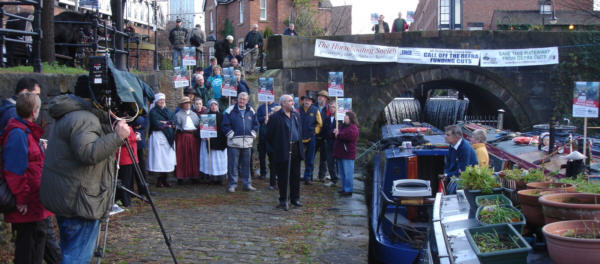
Well, some folks love a good bun-fight and certainly there were plenty of boaters and others interested in waterways who were prepared to come and blockade canals and wave placards to make their voices heard at a time when there was much anger over the swingeing funding cuts made by Defra.
Some people have expressed disappointment that we are no longer mounting such protests. However, it was realised that it was no longer necessary or worthwhile to continue to protest. For one thing, it you keep doing something then it is no longer news and the press loses interest. For another thing, the protests actually achieved a great deal in terms of grabbing the attention of politicians.
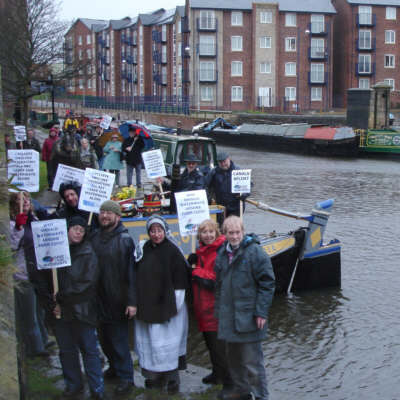
The "flat cash" funding of waterways for this year (whereby the money available remained the same with no allowance for inflation), while being a cut in real spending power, was still better than the deeper cuts that had at one time been threatened. The money situation is not good, but you can be sure that, had waterways supporters not stood up and made a noise, things would have been much worse.
The waterways minister of the time, who had failed to connect adequately with users, was replaced by Jonathan Shaw, who took a more positive approach than his predecessor and showed that he was actually listening. He helped to set up an inter-departmental group for waterways issues, helping to ensure a co-ordinated approach when issues crossed government department boundaries. He also supported the ongoing update of the Waterways for Tomorrow charter for the future of the waterways.
When you have ministers who are moving in the right direction, you support them and work with them rather than embarrass and frustrate them with further protests. So, over the last year or so, rather than engage in further protests, Save Our Waterways has been active in less visible ways. It has involved, with other waterways organisations, in useful discussions with those who make decisions as well as those who aspire to do so.
Save Our Waterways seeks to represent the interests of the many casual users of the waterways. These are probably the majority of users, although they do not contribute financially other than through taxation. This is one reason why Will has been promoting the idea of local councils paying more towards the upkeep of waterways in their area.
Save Our Waterways may not have been in the limelight recently but it has nevertheless been busy behind the scenes!
Subscribe to:
Posts (Atom)
