Save Our Waterways Blog

Tuesday, 31 March 2009

Where have all the protests gone?

There have been a few people who have asked what has happened to all the protest demonstrations that Save Our Waterways was involved with a couple of years ago.

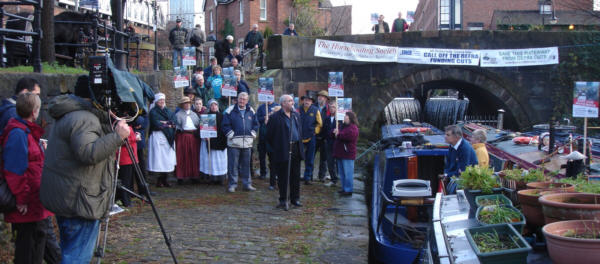
Well, some folks love a good bun-fight and certainly there were plenty of boaters and others interested in waterways who were prepared to come and blockade canals and wave placards to make their voices heard at a time when there was much anger over the swingeing funding cuts made by Defra.

Some people have expressed disappointment that we are no longer mounting such protests. However, it was realised that it was no longer necessary or worthwhile to continue to protest. For one thing, it you keep doing something then it is no longer news and the press loses interest. For another thing, the protests actually achieved a great deal in terms of grabbing the attention of politicians.
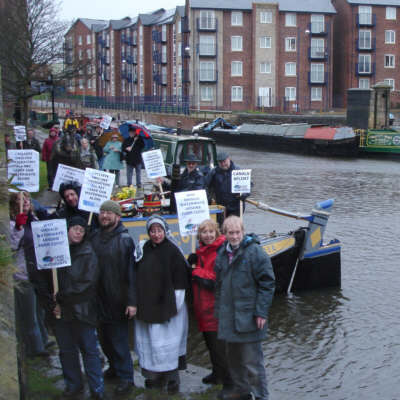
Local MPs came to give their support at the demonstrations and have been involved in a series of debates and enquiries into aspects of the waterways. They badgered ministers with questions from constituents. Ministers took notice of this upswelling of feeling and a further tranche of funding cutbacks that had been threatened (an extra 2.5% cut in November 2006) failed to materialise.

The "flat cash" funding of waterways for this year (whereby the money available remained the same with no allowance for inflation), while being a cut in real spending power, was still better than the deeper cuts that had at one time been threatened. The money situation is not good, but you can be sure that, had waterways supporters not stood up and made a noise, things would have been much worse.

The waterways minister of the time, who had failed to connect adequately with users, was replaced by Jonathan Shaw, who took a more positive approach than his predecessor and showed that he was actually listening. He helped to set up an inter-departmental group for waterways issues, helping to ensure a co-ordinated approach when issues crossed government department boundaries. He also supported the ongoing update of the Waterways for Tomorrow charter for the future of the waterways.

When you have ministers who are moving in the right direction, you support them and work with them rather than embarrass and frustrate them with further protests. So, over the last year or so, rather than engage in further protests, Save Our Waterways has been active in less visible ways. It has involved, with other waterways organisations, in useful discussions with those who make decisions as well as those who aspire to do so.

Save Our Waterways seeks to represent the interests of the many casual users of the waterways. These are probably the majority of users, although they do not contribute financially other than through taxation. This is one reason why Will has been promoting the idea of local councils paying more towards the upkeep of waterways in their area.

Save Our Waterways may not have been in the limelight recently but it has nevertheless been busy behind the scenes!

Thursday, 4 December 2008

EA calls off sale of Thames Lock Keepers' Houses

The Environment Agency has cancelled its plan to sell off some of its lock or weir keeper houses and rent out others. This follows a wave of protests and a petition on the 10 Downing Street website.

In June the Environment Minister Phil Woolas and local MPs met with EA and it was agreed to put the proposals on hold until it has completed "a full review of waterways staff roles and responsibilities, and terms and conditions".

As a result of this review, EA has pledged to ensure that there at resident keepers at all 45 locks and major weirs on the Thames. EA's Howard Davidson said "issues such as flood risk and response to incidents outside normal working hours have been key to our considerations."

EA will still sell five houses that are away from the river, but only after the staff living there have been moved to properties close to locks.

The new proposals, which have to be discussed with staff and unions, have already been welcomed by campaigners and supporters. Cookham lock keeper's wife Kim Benge, who has played a key part in the campaign, said "We are thrilled with the news today. Much work still needs to be done but we are truly delighted with this outcome. The River Thames is a safer place today because of it."

MP Martin Salter, who had compiled a file of incidents at locks and weirs where intervention of resident lock-keepers had saved lives or prevented serious injuries, described it as "fantastic news for everybody who cares about the future of the Thames." He added: "I have no doubt that the weight of public opinion coupled with strong Parliamentary pressure were crucial."

Michael Shefras of Thames User Group (Navigation) said: "We were all delighted to be informed that the proposed plan to sell some of the Lock Cottages has been completely cancelled and that resident Lock Keepers will continue to live in the Lock Cottages. Many Thames organisations worked tirelessly opposing the plan. SOW will continue to work with the Thames User Group (Navigation) who are to continue consultations with the Thames Waterways Staff as they progress the Better Ways of Working process to ensure proper service to all who cruise the Thames."

Wednesday, 26 November 2008

Budget Bonus for BW

...but is there a sting in the tail?

There was good news for British Waterways in the Chancellor's Pre-Budget Report this week.

As part of the Chancellor's measures to give a "fiscal stimulus" to the economy, a grant to BW of £5m will be brought forward from the planned 2011-12 budget. The money will be used as part of a £33m major works programme to repair a range of historic locks, bridges, embankments and reservoirs and dredge channels in waterways across England and Wales.

This shows an acknowledgement that Britain's historic waterways provide excellent value for money for the nation, generating in excess of £500m to the economy each year.

Bringing forward this chunk of cash means that vital work can be carried out sooner and, hopefully, the employment and commerce generated will do its bit towards helping to re-vitalise the economy.

However, it was also announced that, as part of the Operational Efficiency Programme, a team led by Gerry Grimstone will review British Waterways' model for managing its canal-side property portfolio and assess how best public value might be delivered from these assets.

This is causing alarm amongst many waterway enthusiasts, as they fear that the implication is that BW will be forced to sell off its property portfolio through a kind of "fire-sale" and might not even get any of the money!

The fact that a review has been announced doesn't necessarily mean that the assets will be sold off - although that is always one of the possible outcomes. One argument against selling off property at the moment is that it would not bring in sufficient money, with the current downturn in property prices.

Another outcome might be the placing of BW's property and investment operation into a new private sector company run by BW, separate from the public sector navigation operation, as recommended by the KPMG report.

Other points of view state that BW management is somewhat naive to imagine that they could build up a huge property portfolio to help finance its navigation operation, without that portfolio being eyed up and plundered by governments of one colour or another.

So what do you think? Will the extra cash now help? Will BW end up losing its property assets? What does it mean for the future of the waterways?

Add your comment now to have your say!

Tuesday, 7 October 2008

New Minister Announced


The new minister who will have responsibility for waterways is to be Huw Irranca-Davies.

Huw is MP for Ogmore in South Wales and was Parliamentary Under Secretary of State in the Wales Office before getting his new job in the Environment department.

Waterway users will be hoping that Huw will quickly familiarise himself with the many issues that are of great concern, not least the current inadequate funding for waterways. It will also be hoped that he will continue with the encouraging progress made by his predecessor, Jonathan Shaw.

Monday, 6 October 2008

Ministers Moved in Reshuffle

Two ministers closely involved with the waterways have been moved in the Government's reshuffle.

Jonathan Shaw, the former Defra Minister with responsibility for waterways, has moved to the Department for Work and Pensions as a Parliamentary undersecretary of state.

Many waterway groups felt that Mr Shaw took a more positive approach than his predecessor. He helped to set up an inter-departmental group for waterways issues, helping to ensure a co-ordinated approach when issues crossed government department boundaries. He also supported the ongoing update of the Waterways for Tomorrow charter for the future of the waterways.

Phil Woolas who, as Minister for the Environment had overall responsibility for areas that included waterways, has become Minister of State for Borders and Immigration at the Home Office.

As a local MP, Mr Woolas takes an interest in the Huddersfield Narrow Canal, which goes through his constituency. Earlier this year, he travelled on a boat up the locks from Uppermill to Diggle, speaking with boaters about issues of concern to them.

While we wish Mr Shaw and Mr Woolas well in their new jobs, it is sad to see sympathetic ministers move onwards. It takes time for waterways organisations to build relationships with those who make decisions and it takes time for new ministers to gather all the threads of what is going on in their area of responsibility. We hope that enough momentum has been started for recent progress to be continued under new management!

Tuesday, 1 July 2008

EFRA: Sharing the Costs of Canal Restoration

British Waterways should not be expected to bear most of the financial risk for the restoration of canals, says a further report from the EFRA committee.

The House of Commons Environment, Food and Rural Affairs Committee (EFRA) has today published a follow-up report on British Waterways which concludes that if Government wants to obtain the public benefits of canal investment, it should bear the costs.

The report notes that it is estimated that in the first seven years after public investment in waterside regeneration, there are about £6 worth of direct economic benefits for every pound of public money invested. It also notes that these are usually public benefits rather than financial benefits to BW.

The Committee says that canal restoration can produce knock-on benefits such as more jobs and visitor income. But the risks have to be spread more widely among the public sector instead of just BW, which often gets little immediate direct benefit from such work.

The report noted the improvements in the relationship between BW and DEFRA, which had been adversely commented upon in EFRA's original report on BW in 2007. The Committee welcomes the setting up the Interdepartmental Working Group which could lead to a more flexible approach to waterway funding.

The Committee's inquiry was prompted by BW’s decision in February this year to withdraw from the partnership to restore the Cotswold Canals.

The Committee concludes that BW should have consulted its Cotswold Canals restoration partners about its withdrawal earlier, so that they could have had a chance to see if alternative funding was available.

The Committee is "unconvinced" of BW's need to spend up to £600,000 on a report by consultants on its future structure when it is by its own admission short of money. It seems unlikely that there wasn't the expertise within BW, DEFRA or the public sector to conduct the study at lower cost, something which BW should now explain.

British Waterways’ chairman Tony Hales welcomes the report as "an extremely useful contribution to the debate". He adds that the committee's work could only help to enhance the prospect for future waterway restorations.

BW disputes the amount it is paying to consultants, giving a figure of£350,000. The results from this study, due this month, are expected to "set the framework for a debate on the longer term strategy for the waterways in the period to 2020".

(The committee's full report can be read here.)

SOW's View
Will Chapman writes:
The opinion by the EFRA Select Committee that BW should not be expected to carry the risks of canal restoration is clearly good news for BW and goes some way to justify their decision to pull out of the Cotswold Restoration.

BW has a statutory responsibility to keep existing waterways open and safe for navigation. As that is a task that needs £125 million to do properly and as they only have £100 million to do the job it is clear that there is no money to spend on non-navigational matters. This particularly when they have the Mon & Brec to repair and the £10 million costs of last years floods to cover.

EFRA also questions whether it is sound management to spend several hundred thousand on the KPMG structure review. As useful as that study might be, I would agree but I was under the impression that BW initiated the study because they were asked to do so by the former Waterways Minister. If that is the case, should not Government pick up that tab (as indeed they should the cost of containing last year's floods)?

All in all, this announcement is encouraging. It demonstrates a growing realisation that the waterways have a profound impact on the agendas of many other Government departments and we can only hope that the Ministers responsible will recognise this by supporting the Interdepartmental Working Group - another recommendation of EFRA - that has been set up by Waterways Minister Shaw to garner support for the waterways from all its beneficiaries.

Sunday, 22 June 2008

EA holds back on Thames Lock Keepers' houses sale

It is being reported that the Environment Agency is putting on hold its plan to sell off 10 houses and rent out 12 others. This follows a wave of protests and a petition on the 10 Downing Street website.

After a meeting with Environment Minister Phil Woolas and MPs Martin Salter and Theresa May, the EA has agreed to put the proposals on hold until it has completed "a full review of waterways staff roles and responsibilities, and terms and conditions".

In a statement, EA said that no action will be taken to sell or rent lock houses until negotiations on the full review are completed. It was anticipated that this will take six months but their guarantee would continue until all negotiations are completed or 1st January 2009, whichever is later.

EA also said that any future review of the lock keepers' houses would involve the MPs as well as lock keepers' representatives.